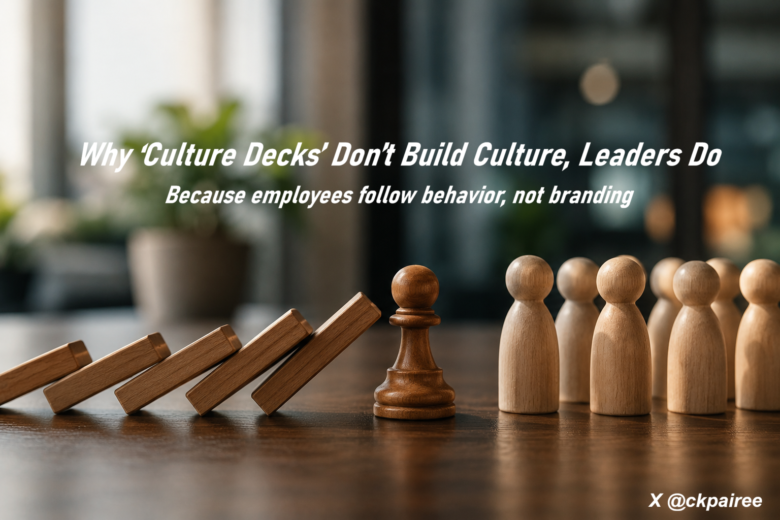
Why ‘Culture Decks’ Don’t Build Culture, Leaders Do
Because employees follow behaviour, not branding
Over the years, I have seen companies spend enormous amounts of time and effort building what they call a “culture deck.” What I usually see are some very beautiful presentations with powerful words and strong value statements. They are thoughtfully designed slides with terms like ownership, innovation, integrity, customer obsession, and people-first leadership.
There is absolutely nothing wrong with any of this.
In fact, clarity of values is definitely important. It gives companies and teams a common language and helps them articulate what they stand for.
But there is one uncomfortable truth I have learned after decades of building teams and businesses across sectors and geographies:
A culture deck does not build culture!
Leaders do!
So, culture is not something that can be created in PowerPoint presentations. It is something that is created in everyday behaviour. People in organizations rarely remember the wording of value statements. But they always remember how the leaders behaved during moments that really mattered and how they were treated,
They remember:
- how decisions were taken during a crisis,
- how disagreements were handled,
- how leaders reacted when targets were missed,
- whether leaders listened,
- whether people were respected under pressure,
- whether accountability applied to everyone, and also
- whether actions matched words.
Now, that is culture.
One of the biggest mistakes organizations make is assuming that culture can just be “announced.” It is not simply a tagline.
Culture is observed, experienced and absorbed silently…over time.
I have often said this to leadership teams: culture is not taught through posters or presentations. Employees learn it by watching what leaders tolerate, reward, ignore, and repeat. After all, leaders are always role modelling, whether they know it or not.
A company may speak about transparency, but if its leaders avoid difficult conversations, employees do notice. A company may speak about innovation, but if managers punish employees every time they fail, teams automatically become risk-averse. A company may say people matter to them, but if employees are treated as expendable during difficult times, trust instantly erodes. And once trust disappears, no culture presentation can bring it back.
The reality is that culture is built in the small moments that rarely make it into leadership presentations.
- It is built when someone junior feels safe enough to disagree openly.
- It is built when leaders remain calm during uncertainty.
- It is built when a leader gives credit to the team rather than themselves.
- It is built when difficult decisions are taken with fairness and empathy.
- It is built when leaders show consistency, especially when nobody is watching.
I remember an incident from earlier in my career that reinforced this lesson for me.
A young employee who was three levels below me had made a series of repeated errors. Rather than asking his manager to deal with it, I called him to my office to understand what was happening.
Fresh out of college, he was terrified. For him, being called to the office of the Managing Director felt like being summoned to the principal’s office. He walked in with his head down, clearly expecting to be reprimanded, or perhaps even lose his job. Instead, I asked him to sit down and calmly asked him to explain what had happened. I listened to his side of the story and reassured him that if he learned from the mistakes and did not repeat them, I would support him completely.
The change was immediate. He left relieved, motivated, and determined to improve. He never repeated those mistakes. Over time, he grew into a highly capable professional and eventually, over several years, became a senior leader within the company. Over the years, he narrated this story to many people and how my belief in him helped him grow as a leader.
What stayed with me was not the correction of the error itself, but the reminder that leadership moments shape culture. Fear may produce compliance for a while but trust often brings out the best in people.
Another incident has stayed with me over the years. One day, I noticed that a young team-lead seemed unusually withdrawn at a company offsite. There was nothing dramatic or obvious. He simply did not seem like himself. I walked up to him, put my arm around his shoulder, and casually asked if something was bothering him. His initial response was predictable, he said everything was fine. But as we continued talking, he slowly began opening up about some challenges he was struggling with. I spoke a few words of encouragement.
He told me, much later, that at the time he had already made up his mind to leave the company. The simple fact that a senior leader had noticed, stopped, and genuinely cared enough to ask how he was doing had changed his perspective. He stayed back, rebuilt his confidence, and over the years went on to take on increasingly senior leadership responsibilities within the organization.
That experience reminded me that culture is often shaped by moments that never appear in performance dashboards or management reports. Sometimes, culture is built simply because a leader notices when someone is struggling and takes the time to listen. In many ways, culture is less about what leaders say and more about who leaders are and this becomes even more important in today’s workplace.
We are leading across multiple generations, hybrid work environments, global teams, and increasing uncertainty. Employees today are far more perceptive. They can immediately sense performative leadership.
- You cannot speak about empowerment while micromanaging every decision.
- You cannot talk about collaboration while rewarding internal politics.
- You cannot preach balance while glorifying burnout.
Teams notice the contradictions much faster than leaders recognize. And in today’s connected world, culture travels quickly, both internally and externally. The organizations that build strong cultures are usually not the loudest about it.
In fact, some of the healthiest cultures I have personally seen were never aggressively marketed. They were quietly practiced. I recently visited a customer in Germany and got a tour of the organization. I could immediately sense a great culture in their organization just based on how the employees were smiling, greeting each other, being simply happy and willing to collaborate. I personally know the CEO, and it was clear to me where the culture came from.
The leadership behaviour itself became the culture communication. If leaders operate with fear, insecurity, politics, and ego, the organization eventually mirrors it. If leaders operate with trust, clarity, accountability, empathy, and integrity, teams begin reflecting those behaviours too.
This is why leadership maturity matters so much.
As organizations grow, leaders often become busy with scale, growth metrics, investor expectations, transformation initiatives, AI adoption, and operational complexity. All of these are definitely important. But somewhere along the way, many tend to forget that culture is not a parallel initiative, but the operating system behind everything else.
A weak culture eventually slows execution, increases attrition, weakens collaboration, and creates internal friction that no strategy deck can solve. On the other hand, a strong culture, creates alignment even during uncertainty.
And the interesting part is this that employees rarely expect perfect leaders, but they do deeply value the authentic ones. Leaders who are human. Leaders who listen. Leaders who stay grounded. Leaders whose behaviour remains consistent under pressure.
That is what people remember, not the culture deck. In the end, culture is not built during annual off sites or leadership workshops, but every single day in meetings, conversations, decisions, feedback, hiring choices, crisis moments, and leadership behaviour.
Every action silently teaches the organization: ‘This is how things are done here.’ That is culture. And that is why culture decks don’t build culture. Leaders do!