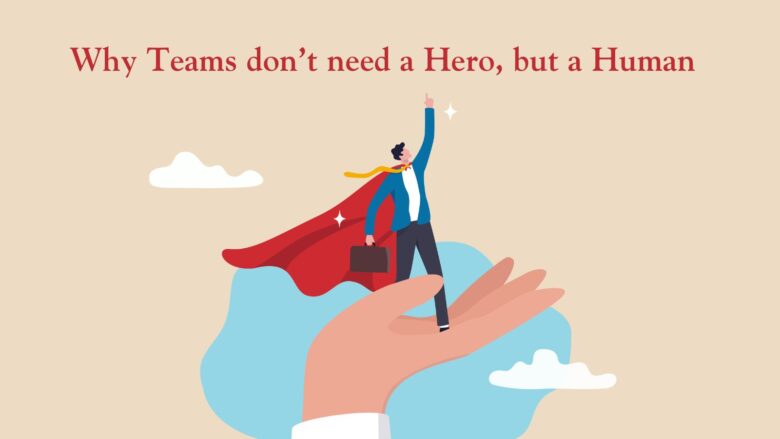
Why Teams Don’t Need a Hero, but a Human
We are often raised on the myth of the ‘Hero’ leader. The lone saviour who swoops in the last hour to save the team and makes impossible decisions. In the corporate world, this individual can be seen as the ‘fixer,’ the leader with all the answers and the one who can thrive in a chaotic environment.
This may seem impressive and may even work for a while. But this quietly damages teams and cultures in the long run. Here is a truth I’ve learned over years of building companies: leadership is not a movie, a sporting event or a battlefield. It is about building people and systems that are enduring and increasing the efficiency of the team by serving as an example.
Heroes may impress you, but a true human connection is what really builds trust. True leadership doesn’t have to be perfect if you want to lead. Instead of trying to solve the entire team’s problems, allow them to grow into their roles to make them truly autonomous.
Why Heroic Leadership Is Misleading
The problem with being the hero leader is the need for a crowd of spectators. Hero leaders often attract “yes people” and praise becomes the currency. The constant need for validation slowly creeps in. When a leader operates from a place of heroics, they create a sense of dependency.
This leads to a situation where a small section of people works to please the leader’s agenda and not the purpose of the organization. Creating a dangerous cycle where the leader’s ego is fed by being needed, and the team’s growth is stunted.
Such a leader may be a high achiever and a go-getter, but he/she is often disconnected from deeper organizational issues. Being full of oneself limits awareness, humility, and awareness.
When a leader insists on being the one to solve every problem, they’re not helping but are over functioning by coming to the rescue every time. A hero leader often tries to solve everything themselves limiting team growth and ownership.
What Teams Actually Need
I’ve always believed that leadership insights don’t necessarily have to come from boardrooms or review meetings.
They can emerge in cafeterias, corridors, and informal settings. Teams don’t need someone who is always in control. They need someone who listens, connects, and uplifts. True leadership is about moving away from the need to be the smartest or loudest in the room to being the person who creates the most room for others.
People want to feel seen, heard, and understood. Business is ultimately about people, and people are central to everything. This is the reason human leadership is critical when it comes to running an effective business.
Empathy in Leadership
A people centric leader understands that they’re not managing resources but are connecting with humans. This change in perspective is important to truly understand your team and what motivates them.
The first step is to build trust by acknowledging emotions and realities. This requires a high degree of emotional intelligence. That is the ability to sense when someone is not okay without them saying a word.
Leadership is sometimes as simple as putting an arm over someone and asking if everything is fine. These are the moments that build real trust. It doesn’t have to be grand gestures but quiet acknowledgement that can be shown through your presence. In my own career, this has saved me from losing several stars who were flight risks but went on to become great leaders.
Creating the Culture that sustains
Human leaders take everyone along, instead of racing ahead alone. Unlike sporting events where it’s important to win the game and people applaud, companies are meant to last, and small wins are like battles needed to get ahead. The team leader has to take the whole team along, unlike sporting or cinematic heroes. True human leaders build systems and structures that enable the whole team to thrive even without the leader at the centre of the system.
Thus enabling others to lead, decide, and grow. In this way, teams feel safe and valued while improving performance.
Final thoughts: Leadership as Humanity
Finally, teams perform well when we see people as complete individuals. As opposed to just roles to be filled. To be a human being is to take into consideration the limits, personal drives, and the nature of emotions. It consists of exchanging the ‘Hero’ cape with ‘Human’ connection.
The next time you are on the verge of saving the day, consider the following: Am I helping my team or am I simply satisfying my desire to be the hero?
The most excellent leaders do not leave a trail of rescues behind them; they leave a trail of other leaders behind them.