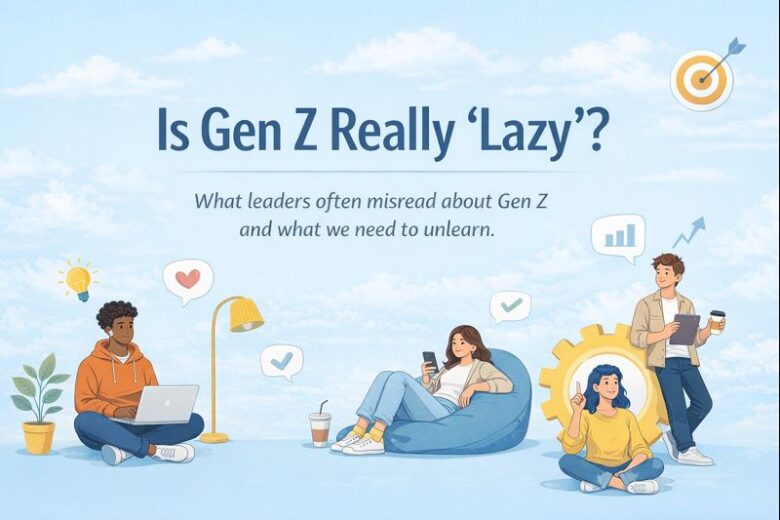
Is Gen Z Really “Lazy”?
What leaders often misread about Gen Z and what we need to unlearn
Every few years, a familiar complaint resurfaces: “This generation is lazy.”
I’ve now heard it said about Gen Z. In the past, I have also heard similar things said about the millennials by Gen X and Gen X were called the same by baby boomers.
But before we decide to label a generation, it’s worth attempting to understand the world that they’re responding to.
So, when people ask me whether Gen Z is lazy, my instinctive response is that “Lazy” is the wrong word to use. What we are witnessing is not laziness, but it is actually a shift in their values, and that is shaped by a very different world that they are living in.
Every generation is a product of its inputs
Each generation grows up with a unique set of inputs. These inputs could be economic realities, social norms, technology, or even access to information.
When we were younger, India was still finding its economic footing. We were a closed economy; Jobs were scarce to find. Job security mattered a lot. Respect was pretty much hierarchical. It was a time when one didn’t question their boss, nor their elders, and you certainly didn’t ask for work flexibility on day one.
Gen Z is growing up in a completely different India and you will agree that it is also a completely different world.
It is a world with:
- Access to unlimited information from world over…thanks to online media.
- Constant exposure to global thinking with technological advancements.
- Tools that also allow them to question, verify, and even validate for themselves
We didn’t have Google or ChatGPT, they do!
So naturally, they don’t just accept what anyone says at face value. They tend to look it up. They cross-check to verify. They then form their own opinions. That’s not really rebellion, but it is self-validation.
To expect them to behave like we did, with entirely different inputs, is quite unrealistic if you ask me.
Ambition has never been uniform
Another uncomfortable truth that we often tend to ignore today is that every generation has ambitious people, and also a set of people who are not.
That was true then. And it is also true now.
I have seen Gen Z professionals who are focused, intensely driven, and crystal clear about what they want in life. I have also alternatively seen some who are completely detached. But that mix has always existed and the generation one is born to has nothing to do with it.
The mistake we make is generalising an entire generation based on the visible behaviours of a few.
Ambition today doesn’t always look like what it used to traditionally. It does not necessarily include long hours, silent obedience, or delayed gratification. Sometimes, it looks pretty simple and it is all about:
- Asking uncomfortable questions early,
- Choosing flexibility over titles,
- Valuing mental health alongside growth, and
- In some cases, instant gratification
That doesn’t make it any inferior. It just makes it ‘different’ and I’ve seen this change before too.
What’s interesting is that this shift didn’t suddenly appear with Gen Z, but I saw it evolve over time. In Theorem, a company I founded years ago, in the early days, people would treat me with a lot of formality. There was hesitation, some distance and also respect expressed through silence.
As time went on, that changed. People would walk up to my room, say hello casually, and speak freely with me. They would reach out to me on social media more confidently than their previous generation. Times were already changing back then.
So, when we say, “This generation is different,” the truth is that the change has always been there. We are only noticing it more now because the contrast feels sharper today. As the nation grows economically stronger, younger generations are earning more than their previous generations and gaining confidence, a natural evolution seen across the world.
Flexibility is not a lack of commitment
One of the biggest points of friction today is around work expectations. Gen Z asks for work-from-home options, flexible hours and clear boundaries. And they are not scared of asking for it upfront.
When we were young, we wouldn’t have dared to. That was partly because we couldn’t and partly because the economic reality of then didn’t allow us to.
Today, there is more disposable income, more choice and even more alternatives. Naturally, priorities have shifted. Remember, asking for flexibility is not the same as refusing to work on something. It is a reflection of agency.
Respect the world they are living in
Instead of labelling, it may be more useful to pause and ask: What world are they responding to?
They are navigating information overload, faster career cycles, constant comparisons and an uncertainty of a different kind. Peer pressures driven by social media makes things even more complex. Their ambition is being shaped by this context. Our responsibility as leaders, founders, and managers, is not to judge them by outdated standards, but to engage with them on newer terms.
As they say, change is the only constant. I am not asking that we lower expectations, but let us redefine how performance, commitment, and ambition are expressed.
Final thoughts
Every generation believes that the next one has it easier. Every generation believes it worked harder than the next one. Some of that may even be true, but that’s normal evolution, isn’t it?
But calling Gen Z “lazy” is a lazy conclusion. They are not less ambitious. They are just differently ambitious.
And if we’re willing to listen, I mean really listen to them, we might even learn something about how ambition itself is evolving.