Why the habits that help us build a business can sometimes prevent it from growing
When scaling a business, we usually talk about new markets, larger teams, better processes, technology and capital. These are all important but there is another aspect of growth that merits attention: the entrepreneur has to grow too.
Having built and grown several organizations, I can say that building a business and scaling it are two very different challenges. The qualities that help us get a business off the ground are not necessarily the same ones that will take it to the next level.
My strengths have always been in building and developing teams, maintaining financial discipline, nurturing client relationships and bringing in new business. These capabilities were particularly important in the early years of the business. However, as we grew, I realised that the approaches that worked with a team of 100 could not simply be scaled to an organisation of over 1,000. The same was true of client relationships, which required different structures and approaches as the business expanded.
In hindsight that sounds obvious but living through that transition is another matter altogether.
Culture and processes must grow together
As entrepreneurs, we bring our own biases, conditioning and ideas about how things should be done. These are shaped by our experiences and personalities, often reinforced by the very things that helped us succeed.
For me, people and relationships are central to building a company. I believe in creating a culture where people trust each other and felt part of something bigger than their individual roles. They treat the company as their own, are allowed to fail and make mistakes while growing.
A good example is Theorem, one of my companies. Many people told us that managing a company like a family would not work at scale. I understood their concerns, but I also believed that our culture was one of our strengths. And in many ways, it worked. We sustained that approach as the company grew, including when the organisation reached over 1,000 people. There was the same passion, commitment and camaraderie.
But sustaining a culture does not mean keeping every aspect of how you operate unchanged.
Other leaders in the company brought different perspectives to the challenge. There was a growing recognition that the informal ways of working that had served us well in the early years needed to evolve. As the organisation expanded, stronger processes, clearer accountability and robust systems became essential to sustaining growth and managing greater complexity.
Looking back, I can see the value of both approaches. Culture and processes are not opposing forces. Culture gives an organisation its character; processes help it function consistently as it grows.
The lesson was not that we had to abandon the way we built the business. It was that we needed to distinguish between the values worth protecting and the practices that had to evolve.
The founder has to evolve too
One of the difficulties of growing a business is letting go of responsibilities that once defined your contribution. When you know the customers, understand the details and can resolve a problem quickly, it is tempting to remain involved in everything. There is satisfaction in being the person everyone turns to. But if every important decision still depends on you, you risk becoming a bottleneck.
Research by economists Nicholas Bloom, Raffaella Sadun and John Van Reenen has examined the relationship between management practices, organisational structures and firm performance. For a growing business, this raises an important question: are we building a team that can make sound decisions, or simply adding people who must wait for us to make those decisions?
Delegation means giving people the authority to make decisions, allowing them to develop their judgement and accepting that their approach may differ from yours. It is not just transferring tasks.
This was part of my own evolution as a leader at Theorem. I had to recognise that the strengths I brought to the business were not enough on their own. The organisation also needed systems, independent decision-makers and the ability to function without my direct involvement in every detail.
The measure of a founder’s contribution eventually shifts from what they personally accomplish to what the organisation can accomplish through others.
Being good to clients does not mean saying yes to everything
Relationships have always been important to how I approach business. We want clients to feel supported, and we often go the extra mile to find solutions. That instinct helps build trust, but it can also create problems when we fail to recognise the commercial realities of running a business.
At the end of the day, a business has to make money. It must serve its clients well while ensuring that the relationship remains commercially viable.
Sometimes, this means pushing back on unreasonable expectations, setting boundaries or recognising that a client relationship is no longer working for either side. Being firm does not mean abandoning our values. It means understanding that accommodating every request can come at a cost to the business and its people.
There is a delicate balance here. Clients may choose to work with us precisely because of our flexibility, personal attention and the way we build relationships. If we become too rigid in the name of efficiency, we risk losing what makes us different.
The challenge is to preserve that distinction while making decisions that are fair to the client, the team and the organisation. Knowing when to say yes and when to say no is as much a leadership skill as building relationships in the first place.
Passion for an idea is not the same as understanding its market
Entrepreneurs and technopreneurs can become deeply attached to their ideas. They understand the problem, believe in their solution and may have spent years developing it. But conviction alone does not establish a market. The fundamental question is whether customers see the problem in the same way and are willing to pay for the solution.
More recently, through my work with the School of Policy and Governance, I have encountered brilliant ideas addressing challenges such as pollution and sustainability. These are important problems, but solving a problem that matters to society and building a commercially viable business around the solution are two different things.
Consider a product designed to keep a home clean while reducing environmental harm. Customers may be willing to pay a premium for the environmental benefit, but only up to a point. Beyond that, affordability, convenience and perceived value will influence their decision. A technically sound solution with admirable intentions does not automatically translate into customer adoption.
This is where entrepreneurs need to learn to zoom in and zoom out. Zoom in to understand the problem deeply and build a compelling solution. Zoom out to challenge their assumptions, see the idea through the customer’s eyes and understand the realities of the market.
The objective is not to lose the passion that drives innovation, but to ensure that it translates into something people genuinely need, value and are willing to pay for.
Building an organisation that can outgrow its founder
As a business matures, the founder’s role changes. Instead of solving every problem, the focus shifts to building an organisation capable of solving problems well.
Can the team manage a difficult customer conversation? Can a manager make a sound decision when the founder is unavailable? Can the organisation maintain its culture and standards as new people join? Can it make the commercial decisions necessary to remain sustainable?
These are meaningful indicators of organisational maturity.
Getting there also requires humility. We must accept that our experience, however valuable, does not make us right every time. Other people may be better equipped to build a process, manage a particular function or challenge an assumption we have held for years. I feel like I learn from Gen-z today more than I can teach them.
The willingness to listen and learn is not a weakness. It is an acknowledgement that the business has evolved and that our leadership must evolve with it.
A question worth asking
If you are building or scaling a business, ask yourself: if I were to step away for a month, would the business continue to make sound decisions, serve its customers well and move forward?
The answer need not be a perfect yes. What matters is what it reveals. Where are decisions unnecessarily concentrated? Which people need more authority? What processes need strengthening? Are we holding on to responsibilities because the business genuinely needs us to, or simply because we have become accustomed to being involved?
My experiences have taught me that scaling is not about choosing between culture and processes, relationships and profitability, or passion and pragmatism. It is about finding a way to make these work together as the organisation evolves.
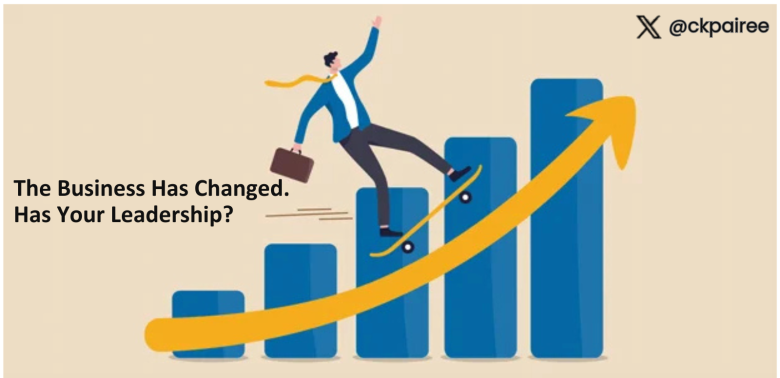
Ultimately, scaling a business is not just about expanding its reach, revenue or capabilities. It is about expanding our own capacity to lead, to listen, to adapt and to see things differently.
The hardest part may not be learning how to grow the business. It may be recognising that we, too, have to grow with it.
And that is a lesson I continue to learn.