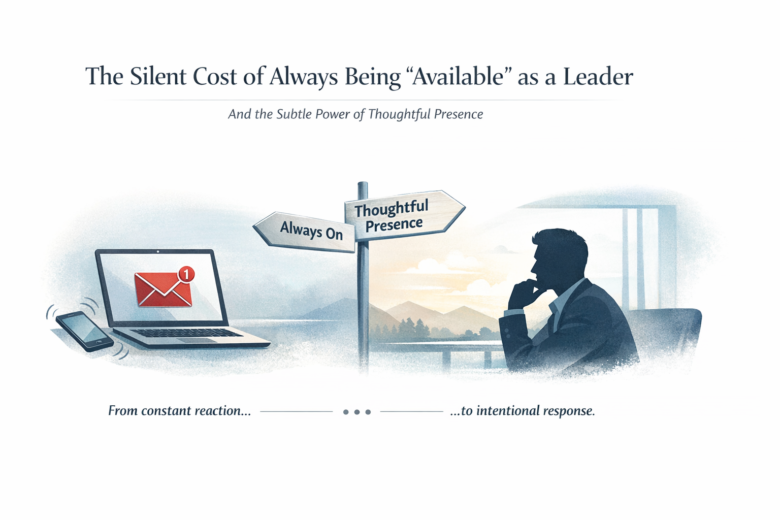
The silent cost of always being “Available” as a leader
And the Subtle Power of Thoughtful Presence
Over the past few months, I have been traveling a lot, and I have been reflecting on a quiet shift within myself…something very subtle, yet powerful. For most of my professional life, I was always available. Always reachable. Always responding. If an email landed, I felt the urge to reply immediately. If someone called, I picked up. If a team member wanted help, I stepped in.
I have always felt that this was simply good leadership. Today, I know it had more to do with my personality type, and also the value system I grew up with.
Some of us are wired to show up. To be dependable. To never keep people waiting. And so we carry this ingrained belief that responsiveness equals responsibility.
But here’s the uncomfortable truth: Being available, by itself, doesn’t define a leader’s value. Without thoughtful boundaries, constant availability can quietly dilute how that value is perceived.
Perception Shapes Power
Years ago, at Theorem, a senior leader who reported to me asked me something that stuck with me for a long time.
“Why do you make yourself so available?” he asked. “You know, sometimes your value may go down because of this availability”
At first, I was puzzled. I had always believed that being approachable, responding immediately, and stepping in whenever needed was simply good leadership. Why would that be a problem?
He explained it in a way that really made me think. “When we were younger, seeing the CEO was a big deal. You looked forward to it. It was special. When a leader is everywhere all the time, those moments lose some of their significance. People stop pausing and noticing; they start taking presence for granted”, he said.
That conversation has stayed with me. It’s another matter that I didn’t change because of what he said, but it’s something I reflect on till today.
The point wasn’t to be distant. It was to recognize the subtle power of presence, that being intentional about your availability can make your time and attention more meaningful.
Leaders aren’t valued just for what they know or how hard they work. They’re valued based on how others perceive their time, presence and boundaries.
When you’re always accessible, the perception quickly becomes:
- “He’ll respond immediately.”
- “She’ll jump in.”
- “Let’s send it to him, he won’t say no.”
And before you realise it, your availability becomes an invitation for more tasks, more dependency, more people taking advantage of the fact that you don’t push back.
The Shift from Immediate Reaction to Intentional Response
The biggest change in me lately is this: I no longer feel the need to respond instantly.
Earlier, there was a pressure and almost a psychological need to acknowledge every message, every ping, and every request. Today, I am able to pause.
Not because I don’t care, but because I finally recognise that urgency is rarely real.
This shift didn’t happen overnight. It came from experience, from burnout, being taken advantage of and from understanding how personal boundaries influence professional perception.
I’ve realised: Not replying immediately doesn’t make me irresponsible.
Taking my time doesn’t make me any less committed.
Pausing before responding often leads to better decisions. You can read my blog on this here.
The Personality Trap We Don’t Talk Enough About
Many leaders who struggle with over-availability aren’t facing a discipline challenge; it’s more about how their personality is wired.
We respond because:
- It’s in our nature.
- We feel accountable.
- We don’t want to seem indifferent.
- We think delaying is disrespectful.
But leadership is not about pleasing. It’s about prioritising.
Being available 24×7 might feel noble, but it often leads to blurred boundaries, unnecessary stress, poor perception management, and also people assuming you have endless capacity.
This is the silent cost most leaders don’t account for.
And remember, some responses wait for the right moment and some decisions are held strategically, not instantly.
In leadership too, timing matters.
Not reacting immediately can be a strength, not a weakness.
Final Thoughts
If you’re someone who is always available, always responsive, always “on,” pause and ask yourself: Is this my responsibility? Or is it my conditioning?
Leadership today requires clarity, presence, strategic timing and most importantly, boundaries.
Being available has its value. Being always available has a cost and it is often an invisible one.
And the moment you recognise this, your leadership changes.
Quietly. Powerfully. Permanently.